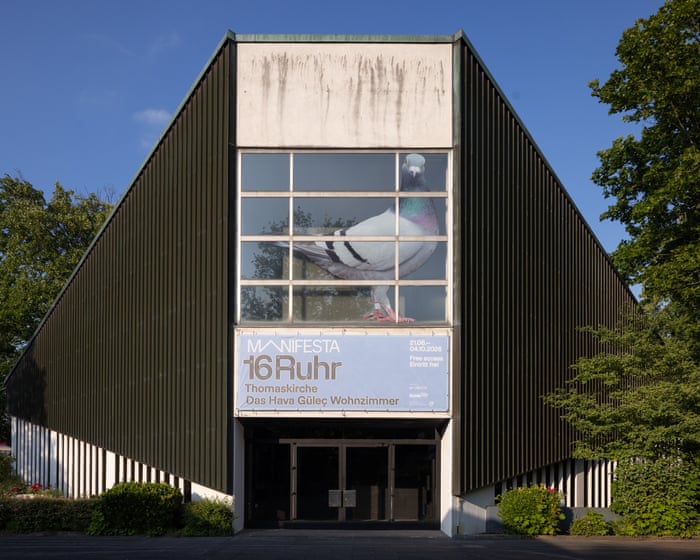
A Ruhr treat: can a giant pigeon and a pink basketball revive Germany’s depressed industrial heartland?
The Manifesta biennale is taking over a dozen tiny churches in German towns ravaged by division and decline – and filling them with ball games, bouncy castles and a radical community spirit
After Germany’s Ruhr conurbation – the third-largest urban area in western Europe – was pummelled during the second world war, planners came up with an ingenious idea. About 80% of the sprawl – which incorporates big cities such as Essen and Duisburg, and dozens of smaller towns like Bochum and Gelsenkirchen – had been destroyed. And so, for the reconstruction, a newly formed Diocese of the Ruhr built literally hundreds of closely packed Pantoffelkirchen or “slipper churches”, so named because they were close enough to housing developments for churchgoers to walk to mass in their slippers.
Today, Pantoffelkirchen are declining sharply. Estimates of the amount of disused or derelict churches are as high as 300, and 100 have been sold off in the last year alone. Until October, 12 of them are home to Manifesta, the travelling art biennale. They stand as centrepieces of communities that have been ravaged this time not by war, but by deindustrialisation, mass unemployment and environmental decline.
Continue reading...
Jul 20, 2026
Architecture
Art and design
Culture