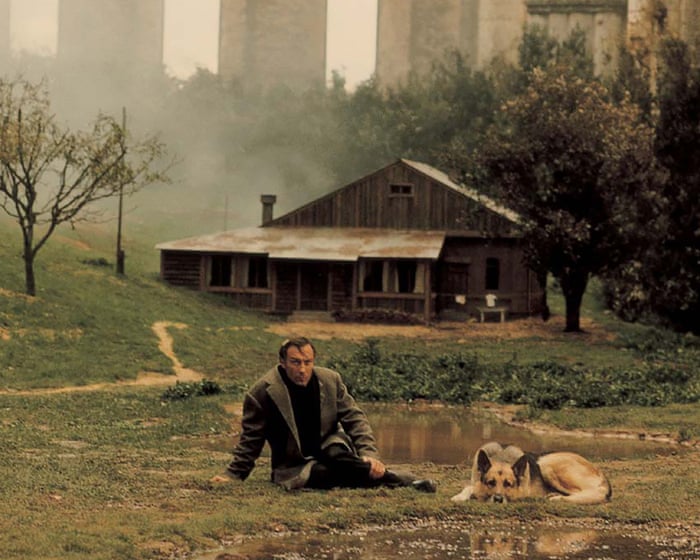
Nostalgia review – Tarkovsky’s yearning cine-poem is deeply mysterious and profound
A scholar has an existential crisis while researching the life of a composer in the Russian director’s Italy-set 1983 masterwork
Andrei Tarkovsky’s 1983 film is a mysterious, imagist cine-poem about alienation and belonging, whose title means a yearning not simply for a lost time or lost place but for something, anything, else – with a profound anguished sense that the here-and-now of existence is unsatisfactory.
The movie takes something from the poetry of the director’s father Arseny Tarkovsky, which is quoted in the film. A distinguished Russian scholar is in Italy to research the life of the (fictional) Russian composer Pavel Sosnovsky who is supposed to have travelled there before being overwhelmed by homesick longing and returning to the motherland. His beautiful, flirtatious interpreter is reading Tarkovsky’s poetry in an Italian translation, and the Russian coldly tells her to throw the book away: “Poetry is untranslatable, like the whole of art.” Does he really mean that? This movie is itself, in a way, translated; it is set in Italy and co-written by Tarkovsky with the veteran Italian screenwriter Tonino Guerra, who worked with Fellini and Antonioni. (Like Jean-Claude Carrière, Guerra, who died in 2012, was a prolific collaborator in European cinema.)
Continue reading...
Jul 22, 2026
Film
Drama films
Andrei Tarkovsky