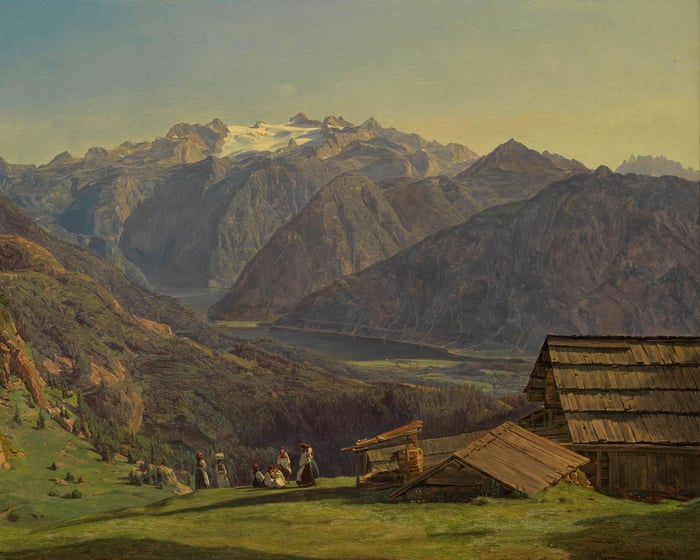
Waldmüller: Landscapes review – the rule-breaking radical whose ‘delicate fingers’ drove bourgeois Austria wild
National Gallery, London
He painted leaves, grass and even bark with the precision of a chef applying a micro-garnish with tweezers. The result? Looking at his work feels a lot like eating your greens
Ferdinand Georg Waldmüller (1793-1865) is regarded as one of the most important figures in 19th-century Austrian art; an influential and admired teacher, and a somewhat radical figure regarding the established Viennese Academy. He worked during the Biedermeier movement which spanned the end of the Napoleonic wars until 1848 when various revolutions shook the ruling Habsburg empire and Austrian political elite. Biedermeier reflected the tastes and aspirations of a rising bourgeois society; terribly nice landscapes, genre scenes, floral and portrait pieces for the upwardly mobile drawing room. Within these genteel confines, Waldmüller intently focused on a more unflinching mode of depiction, concerned more with accuracy and integrity than the sentimentalising efforts of his peers, while also criticising the Academy’s teaching methods and eventually in 1857 even calling for the abolition of all academies.
If this collection of relatively small, minutely detailed landscapes is representative of an impassioned, radical painter tearing up the rule-book, it is far from obvious from their tightly controlled, rather unimposing visual appearance. Each shows a vista of a specific location – The Ruins of the Temple of Juno Lacinia near Agrigento (1846), View of the Dachstein from the Sophien-Doppelblick near Ischl (1835) – accompanied by captions which systematically list topographical details of note, followed by some light technical analysis: for the latter, “Waldmüller has distinguished the successive elements in the landscape with distinct changes in tonality, from the soft green of the valley to the blue-grey of the most distant mountains.” In the show’s only portrait, 1828’s Self Portrait as a Young Man, which incidentally dwarfs everything else here in scale, the caption draws attention to “his delicate fingers proclaiming his sensitivity and talent”: delicacy and sensitivity are the operative descriptors for the entire show.
Continue reading...
Jun 30, 2026
Painting
Art
Art and design